Sprache ändern:

Rotary Valves
Neue JÄGER Maschinenbau
The Rotary Valve Manufacturer

Neue JÄGER Maschinenbau

Rotary Valves of Industrial Quality – Reliable and Precise

If you are looking to purchase rotary valves that meet the highest technical standards, Neue JÄGER is the right partner for you. For many years, we have been developing and manufacturing rotary valves for the controlled discharge, dosing, and conveying of bulk materials in a wide variety of industrial applications.

Our solutions stand for durability, precision, and individual adaptability. Whether you need a standard model or a customized design, you can purchase rotary valves from us that are precisely tailored to your processes. We support you from the initial technical consultation to the finished valve and ensure reliable integration into your system.

We would be happy to advise you – please give us a ring!

Productportfolio

Rotary valves of Neue JÄGER: our product portfolio

Our products are used worldwide as top-of-the-line components for the controlled discharge and metering of bulk materials such as granular or powdery pellets, powders, granules, and much more. As an experienced rotary valve manufacturer, we primarily serve customers in the food and beverage industry, the chemical, pharmaceutical, and process engineering sectors, as well as the plastics and minerals industries.

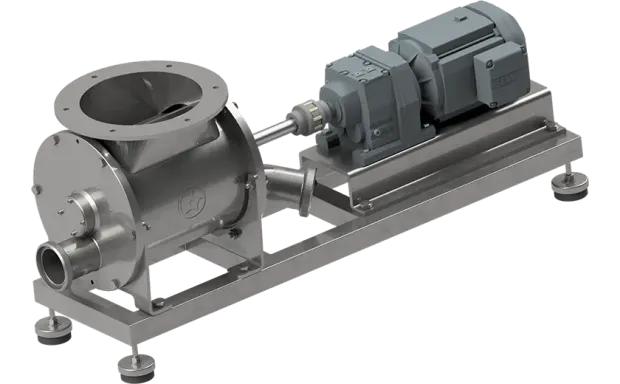
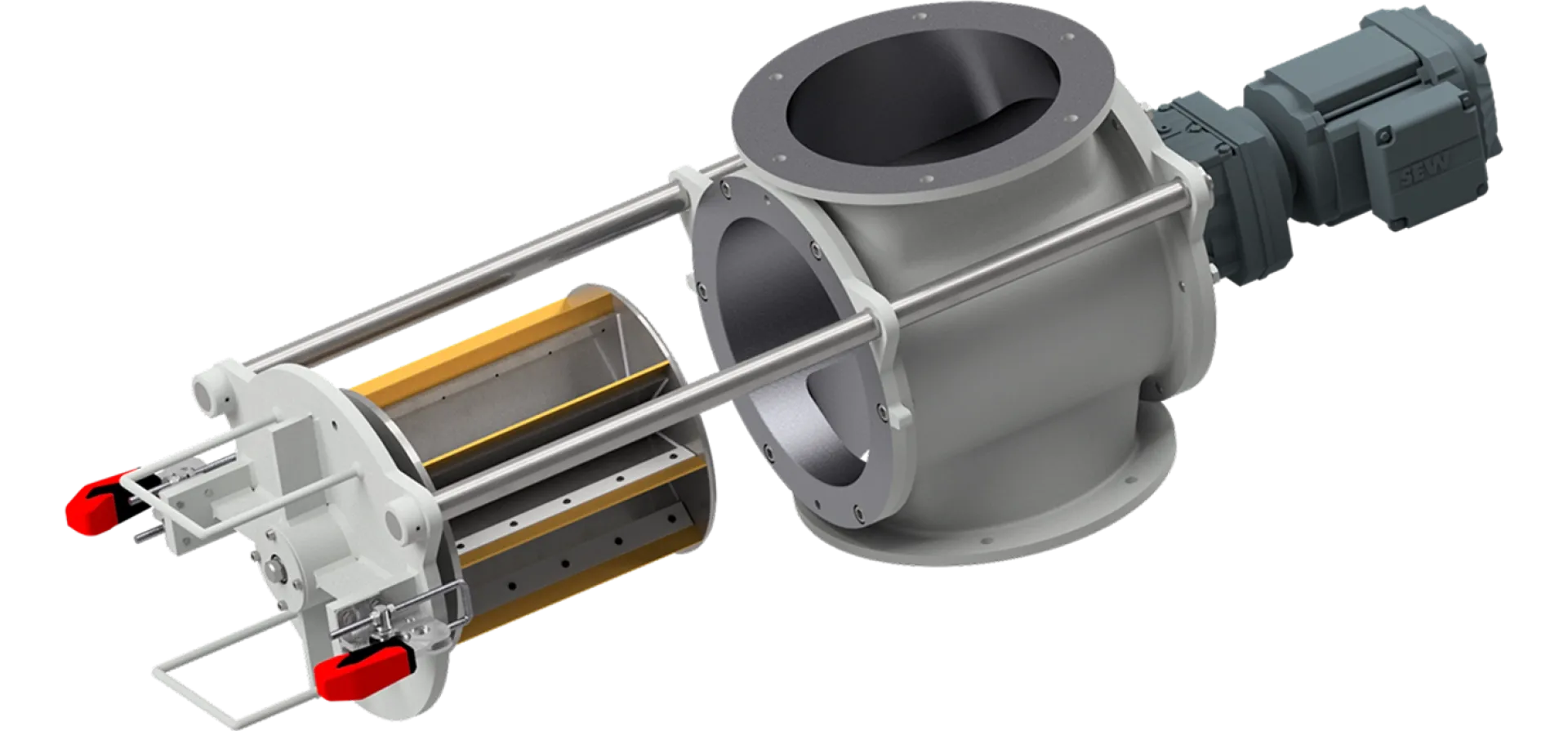
We have the right rotary valve for every application. Depending on the application, a wide variety of rotary valve types are suitable. Neue JÄGER rotary valves meets every requirement, whether you are looking for a rotary valve for pneumatic conveying, a medium-pressure or high-pressure rotary valve, ATEX-compliant rotary valves according to EU-Directive 2014/34/EU, or a tangential rotary valve.

Product line

Rotary Valves for Pellets, Powders & More: Select Your Rotary Valve Based on Applications and Use Cases

Rotary valves are indispensable in modern bulk material handling. They perform a wide variety of tasks for dosing, feeding, or discharging bulk materials. The conveyed medium can have a wide range of properties that the rotary valve must manage reliably.

Therefore, simply select your rotary valve based on your application: we have the right rotary valve with various chamber volumes for bulk materials, granules, plastics, pellets, and much more. As product developers, we also offer customized solutions. Simply contact us to discuss all the details personally.

About us

Your partner in machine and plant construction

In addition to the development and manufacture of rotary valves for demanding applications, we also undertake various activities for you in the field of mechanical and plant engineering. As a product developer and special machine builder with a modern and very well-equipped machine park, we are there for you in all aspects of CNC turning, CNC milling and more. Get more information about our contract manufacturing in mechanical engineering here.

Your Rotary Valve Manufacturer Since 1985

Neue JÄGER has been your rotary valve manufacturer since 1985. Today, Neue JÄGER is among the leading rotary valve manufacturers, developing, producing, and distributing a wide variety of rotary valves for diverse applications. Depending on product characteristics, requirements, and operating conditions, we provide suitable solutions that meet the highest quality standards.

We are one of the few rotary valve manufacturers who, thanks to our comprehensive and variable modular design system, can easily adapt the dimensions of our rotary valves to various flange dimensions and standards according to DIN or ASME, as well as to different installation heights – for your rotary valves, blow-through rotary valves, tangential rotary valves, or scraper valves.

We would be happy to advise you – please give us a ring!

Frequently asked questions about rotary valves

What is a rotary valve?

A rotary valve is used in bulk material handling technology for discharging and metering bulk materials. The functionality and design of rotary valves are similar to those of pumps and compressors. While the fluid in pumps is liquid and in compressors gaseous, rotary valves transport bulk materials and other solids.

The rotary valve is used for the metered conveyance of bulk materials. It transports materials such as powder, granules, grain, or pellets between two areas, even with different pressure conditions.

What are rotary valves used for?

Rotary valves are used in many industries, for example, in food technology, plastics processing, the chemical industry, the cement industry, and biomass conveying. They are used for metering, discharge, and pressure relief and are often part of pneumatic conveying systems. Rotary valves are often installed under silos and bunkers to relieve the silo pressure on the bulk material.

What materials can be conveyed with a rotary valve?

Dry and free-flowing bulk materials such as road salt, animal feed and feed pellets, plastic granules, or wood pellets are conveyed.

Abrasive or sensitive materials can also be processed with special designs. It is crucial that the material flows freely and does not tend to stick together.

How does a rotary valve work?

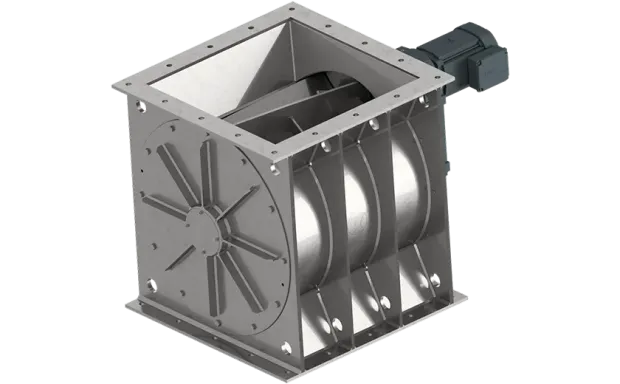
Inside the rotary valve, a cell wheel or rotor rotates with several chambers – called cells or chambers. These collect the bulk material at the inlet and convey it to the outlet. The gap between the rotary valve and the housing ensures that the system remains pressure-tight to a certain degree, which is especially crucial for pneumatic conveying.

What pressure differences can be managed with rotary valves?

Rotary valves can handle pressure differences of up to 3.5 bar. Simple rotary valves with 8 chambers can be used for pressure differences of up to 0.5 bar. Medium-pressure rotary valves up to 1.5 bar or high-pressure rotary valves up to 3.5 bar are then equipped with cell wheels with up to 18 chambers.

Are there different types of rotary valves?

Yes, there are many variants. Depending on the application and demands, a distinction is made between standard rotary valves, blow-through valves for pneumatic conveying, rotary valves, and tangential valves.

Are there different versions of individual rotary valves?

There are different versions for each type of rotary valve, such as temperature-resistant, hygienic, or explosion-proof models.

The material design also varies – for example, stainless steel versions for food or wear-resistant coatings for abrasive media.
The selection of the right material, bearings, or sealing system always depends heavily on the material being conveyed and the ambient conditions.

Can rotary valves be used in potentially explosive atmospheres?

Rotary valves are nowadays frequently used as protective systems in many potentially explosive atmospheres under the EU Directive 2014/34/EU.

In general, the directive distinguishes between devices that are designed to be free of ignition sources or pressure shock-resistant and autonomous protective systems.

Autonomous protective systems are flameproof and serve for explosion isolation or as safety devices for burn-back protection. These are very often also referred to as flameproof devices.

Can rotary valves be used for sealing air or gases?

Rotary valves can reduce the ingress of air or gases into sealed systems or piping networks. Rotary valves with a very small gap between the rotor and the housing of up to 0.1 mm are often used for so called gas tide rotary valves. Rotary valves with up to 18 chambers, resulting in a very large sealing surface, minimize the air penetration. Additionally, rotary valves can be equipped with leakage air connections or a separate leakage air collector.

How do you choose the right rotary valve?

The correct design of a rotary valve depends on factors such as flow rate, material and material properties, type of bulk material, ambient temperature, pressure conditions, installation location, and environmental conditions. Hygiene requirements or the use of rotary valves in ATEX areas also play an important role. A customized design ensures optimal function and a long service life of the system.

Are rotary valves maintenance-free?

Modern rotary valves are low-maintenance but should be inspected regularly. Seals and bearings, in particular, are wear parts that should be replaced as needed. Many models offer easy access for cleaning and maintenance, which minimizes downtime.